
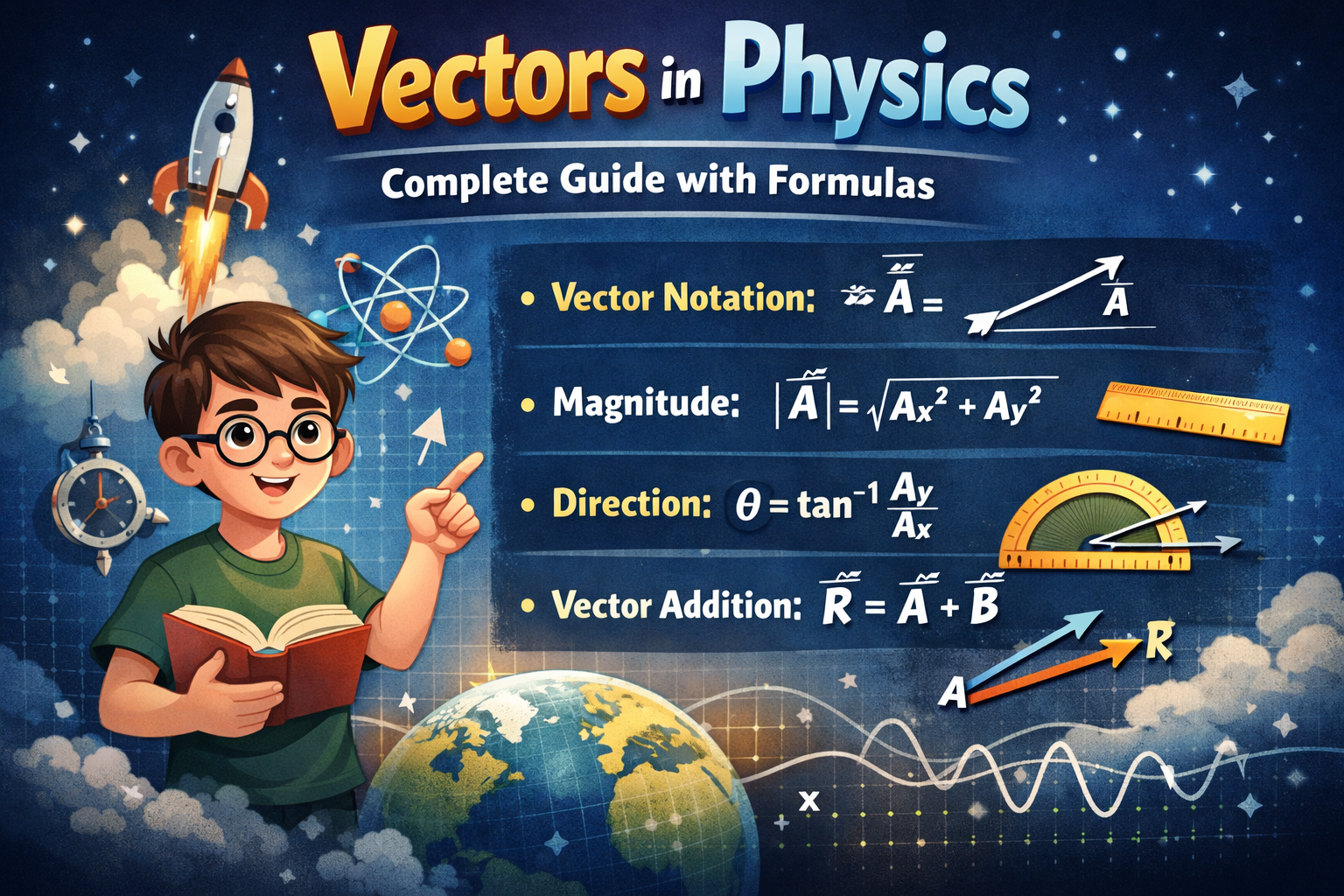
Vectors are one of the most fundamental concepts in Physics and Mathematics. From displacement and velocity to torque and angular momentum, vectors play a crucial role in understanding motion and forces in the real world.
In this detailed guide, we will cover:
- Definition of vectors
- Types of vectors
- Laws of vector addition
- Scalar and vector products
- Resolution of vectors
- Relative velocity
- Important formulas and exam tips
This article is designed for Class 11 & 12 students, TNPSC aspirants, and competitive exam preparation.
What is a Vector?
A vector is a physical quantity that has:
- Magnitude
- Direction
- Obeys the laws of vector algebra
Examples of Vector Quantities
- Displacement
- Velocity
- Acceleration
- Force
- Momentum
- Torque
- Angular velocity
⚠ Important Concept:
Not every quantity with magnitude and direction is a vector.
For example:
Electric current has magnitude and direction, but it is a scalar because it does not obey vector addition laws.
Types of Vectors (Very Important for Exams)
1. Equal Vectors
Two vectors are equal when:
- Their magnitudes are equal
- Their directions are the same
2. Parallel and Anti-Parallel Vectors
Parallel Vectors:
- Same direction
- One is a positive multiple of the other
Anti-Parallel Vectors:
- Opposite direction
- One is a negative multiple of the other
3. Collinear Vectors
Vectors that lie along the same straight line are called collinear vectors.
Minimum number of collinear vectors required for zero resultant = 2.
4. Zero (Null) Vector
- Magnitude = 0
- Direction = Undefined
5. Unit Vector
A unit vector represents only direction.
If vector A is given:
 = A / |A|
Properties:
- Magnitude = 1
- No units
- No dimensions
6. Polar and Axial Vectors
| Polar Vectors | Axial Vectors |
|---|---|
| Displacement | Torque |
| Force | Angular Momentum |
| Velocity | Angular Velocity |
Axial vectors follow the Right Hand Rule.
Laws of Vector Addition
Understanding vector addition is extremely important for exams.
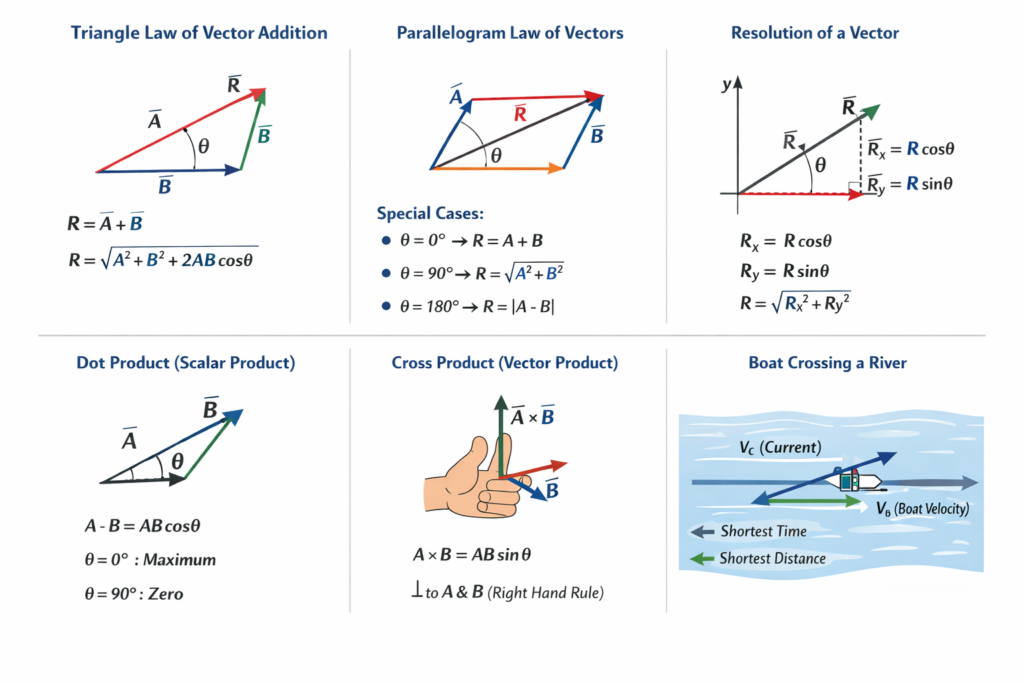
Triangle Law of Vector Addition
If two vectors are represented by two sides of a triangle taken in order, the third side taken in reverse order represents the resultant.
Resultant Magnitude Formula:
R = √(A² + B² + 2AB cosθ)
Where:
θ = angle between vectors
Direction Formula:
tanα = (B sinθ) / (A + B cosθ)
Parallelogram Law of Vector Addition
If two vectors are represented by adjacent sides of a parallelogram, the diagonal represents the resultant.
Special Cases:
- If θ = 0° → R = A + B (Maximum)
- If θ = 180° → R = |A − B| (Minimum)
- If θ = 90° → R = √(A² + B²)
Polygon Law of Vector Addition
If multiple vectors are arranged head-to-tail forming a polygon, the closing side represents the resultant.
Important Note:
- Resultant of two unequal vectors can never be zero.
- Three non-coplanar vectors can never give zero resultant.
Subtraction of Vectors
Vector subtraction is defined as:
A − B = A + (−B)
Multiplying a vector by −1 reverses its direction.
Resolution of Vectors into Components
If vector R makes angle θ with x-axis:
Rx = R cosθ
Ry = R sinθ
Magnitude:
R = √(Rx² + Ry²)
Direction:
tanθ = Ry / Rx
Important:
Rectangular components can never be greater than the vector itself.
Scalar Product (Dot Product)
Definition:
A · B = AB cosθ
Properties:
- Result is scalar
- Commutative
- Distributive
Important Conditions:
- Maximum when θ = 0°
- Zero when θ = 90°
- Minimum when θ = 180°
Applications in Physics:
- Work = F · S
- Power = F · V
- Magnetic Flux = B · A
If A · B = 0 → Vectors are perpendicular.
Vector Product (Cross Product)
Definition:
A × B = AB sinθ
Direction:
Perpendicular to plane of A and B (Right Hand Rule)
Properties:
- Not commutative
- Maximum when θ = 90°
- Zero when vectors are parallel
Important Applications:
- Torque = r × F
- Angular momentum = r × p
- Force on moving charge = q (v × B)
Lami’s Theorem (Important for Equilibrium Problems)
If three forces acting at a point keep a body in equilibrium:
F₁ / sinα = F₂ / sinβ = F₃ / sinγ
Used in force equilibrium problems.
Relative Velocity – Complete Explanation
Relative velocity of particle P₁ with respect to P₂:
V₁₂ = V₁ − V₂
Special Cases:
- Same direction → V₁ − V₂
- Opposite direction → V₁ + V₂
- Perpendicular direction → √(V₁² + V₂²)
Important Applications
1. Rain and Moving Observer
Used to find apparent direction of rainfall.
2. Boat Crossing River
Two cases:
- Shortest distance
- Shortest time
3. Satellite Motion
Relative velocity depends on direction of Earth’s rotation.
Important Exam Points & Conceptual Notes
✔ Distance is scalar
✔ Displacement is vector
✔ Division of vectors is not defined
✔ Minimum coplanar vectors for zero resultant = 3
✔ Maximum resultant when θ = 0°
✔ Minimum resultant when θ = 180°
Angle Between Two Vectors:
cosθ = (A · B) / (|A||B|)
Projection Formula:
Projection of A on B = (A · B) / |B|
Frequently Asked Questions (FAQ)
Q1: Is electric current a vector?
No. It has direction but does not obey vector algebra.
Q2: When is resultant maximum?
When two vectors are parallel.
Q3: When is resultant minimum?
When vectors are anti-parallel.
Q4: When are two vectors perpendicular?
When their dot product is zero.
Conclusion
Vectors are the backbone of mechanics and advanced physics. Mastering:
- Vector addition
- Dot and cross product
- Component resolution
- Relative velocity
is essential for scoring high in:
- TNPSC
- NEET
- JEE
- Board Exams