
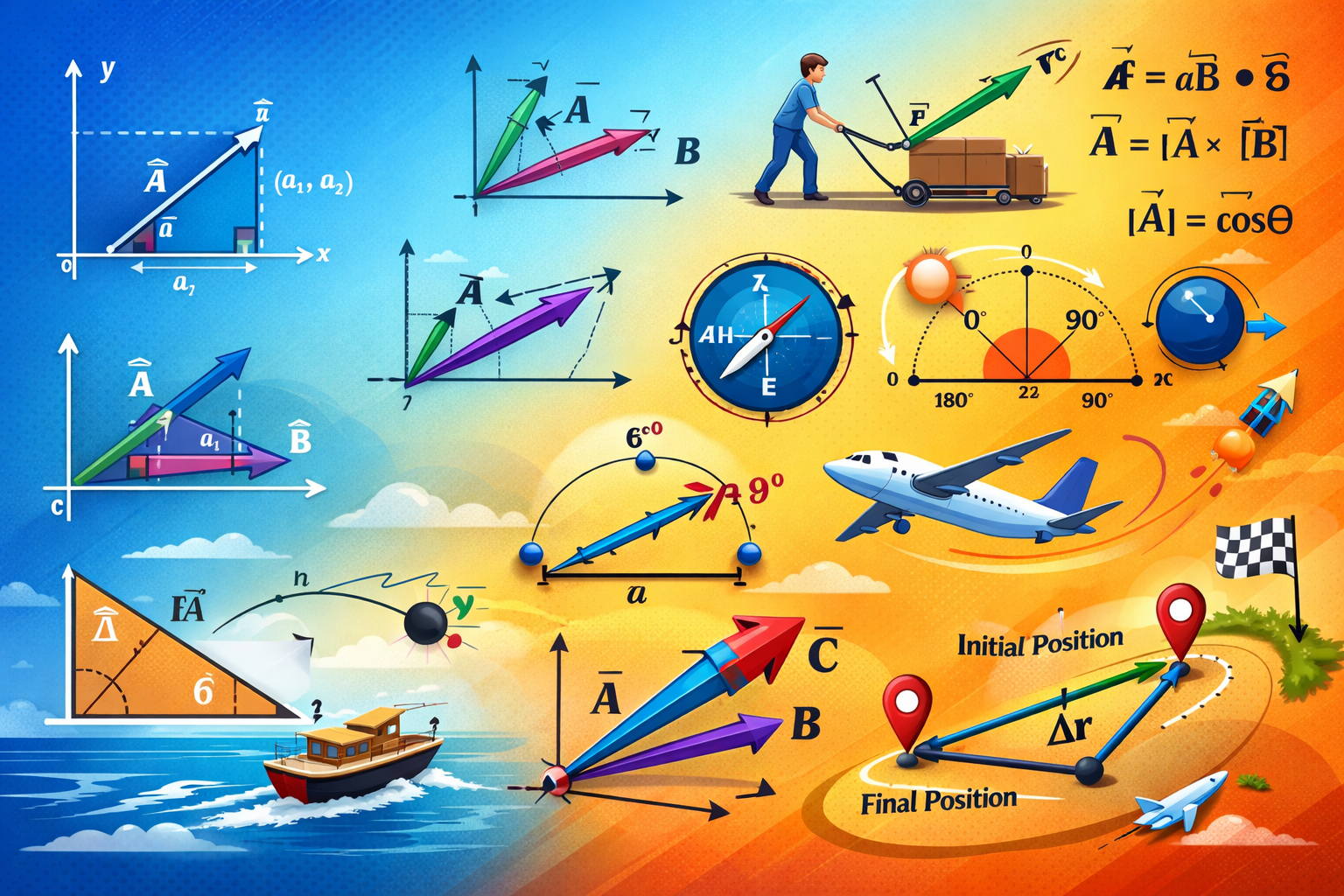
Vectors – Complete Notes, Formulas & Tricks for Competitive Exams
Vectors is one of the most important chapters in Physics for NEET, JEE, TNPSC, CET and other competitive exams. Almost every exam asks 2–4 direct or concept-based questions from this chapter.
In this article, we will cover:
- Fundamentals of Vectors
- Addition and Subtraction of Vectors
- Dot Product (Scalar Product)
- Cross Product (Vector Product)
- Lami’s Theorem
- Relative Velocity
- Important Exam Tricks
Let’s start from the basics.
1. Fundamentals of Vectors
✅ What is a Vector?
A vector is a physical quantity that has:
- Magnitude (value)
- Direction
Examples of Vector Quantities:
- Displacement
- Velocity
- Acceleration
- Force
- Momentum
What is a Scalar?
A scalar has only magnitude.
Examples:
- Distance
- Speed
- Work
- Energy
- Pressure
- Surface Area
👉 Very Important: Work is scalar, even though force is vector.
Position Vector
If a particle is located at point (x, y, z), its position vector is :
Example:
Point (3,2,5)
Displacement Vector
If a particle moves from
P(x₁,y₁,z₁) to Q(x₂,y₂,z₂)
Magnitude of a Vector
IfA=xi^+yj^+zk^
Then,
Direction Cosines
If a vector makes angles α, β, γ with X, Y, Z axes:l=cosα m=cosβ n=cosγ
Important relation:l2+m2+n2=1
This is a frequently asked MCQ concept.
2. Addition and Subtraction of Vectors
Triangle Law of Vector Addition
If two vectors are represented by two sides of a triangle taken in order, the third side represents the resultant.
Parallelogram Law
If angle between two vectors A and B is θ:
🔥 Special Important Cases
| Angle | Resultant |
|---|---|
| 0° | Maximum = A + B |
| 180° | Minimum = |
| 90° | √(A² + B²) |
👉 Resultant is maximum when vectors are parallel.
👉 Resultant is minimum when vectors are opposite.
Minimum Number of Vectors to Give Zero Resultant
- Coplanar vectors → Minimum 3
- Non-coplanar vectors → Minimum 4
Very important for assertion-reason questions.
3. Multiplication of Vectors
There are two types:
- Dot Product
- Cross Product
Dot Product (Scalar Product)
Result → Scalar
Important Points:
- If θ = 90° → Dot product = 0
→ Vectors are perpendicular - If θ = 0° → Maximum value
Applications of Dot Product
✔ Work Done
W=F⋅s W=Fscosθ
If θ = 90° → Work = 0
✔ Power
Cross Product (Vector Product)
Result → Vector (perpendicular to both)
Important Points:
- If θ = 0° or 180° → Cross product = 0
→ Vectors are parallel - Cross product is NOT commutative
Applications of Cross Product
✔ Torque
✔ Angular Momentum
✔ Area of Parallelogram
4. Lami’s Theorem
If three forces P, Q and R act at a point and body is in equilibrium:
Conditions:
- Forces must be coplanar
- Must act at one point
- Body must be in equilibrium
Very important for equilibrium problems.
5. Relative Velocity
Relative velocity of A with respect to B:
Important Cases
Same Direction
Subtract velocities
Opposite Direction
Add velocities
River Problems Tricks
✔ Shortest Time → Swim perpendicular to river
✔ Shortest Distance → Swim at angle upstream
These are very commonly asked in entrance exams.
🔥 Most Important Exam Tips
✅ Dot product zero → Vectors perpendicular
✅ Cross product zero → Vectors parallel
✅ Resultant maximum at 0°
✅ Resultant minimum at 180°
✅ Minimum coplanar vectors for zero resultant = 3
✅ Work is scalar
✅ Cross product gives axial vector
Conclusion
Vectors is a scoring chapter in Physics. Most questions are formula-based and concept-oriented. If you understand:
- Dot product
- Cross product
- Resultant formula
- Relative velocity
You can easily score full marks from this chapter.